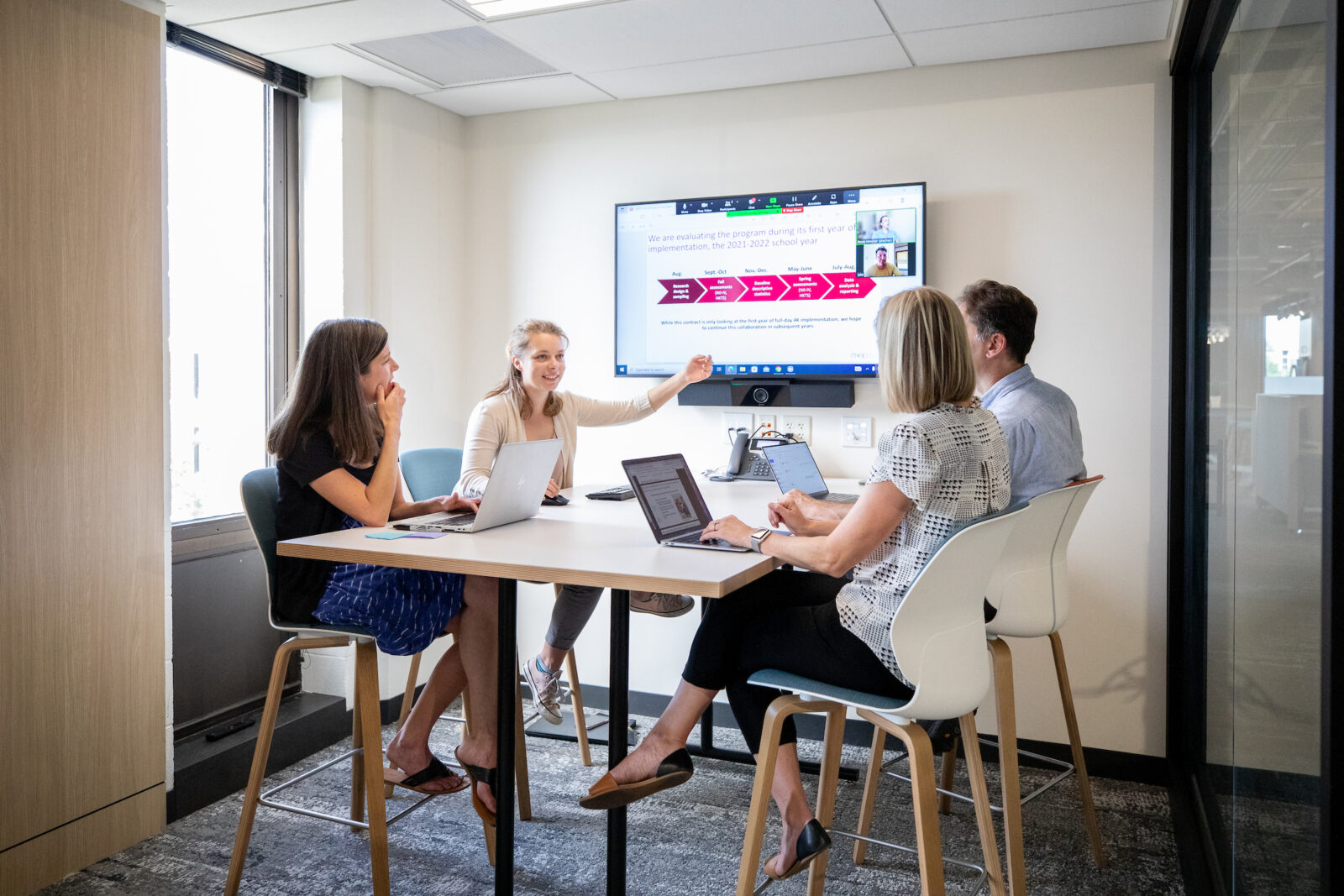
Projects and Initiatives
Advancing Innovative Research in Education
The Wisconsin Center for Education Research (WCER) is a community of researchers engaged in a wide range of projects and initiatives that examine teaching and learning, education systems, and policy. These efforts bring together researchers, educators, and partners to address complex challenges and improve outcomes for learners.
WCER projects advance education through leading interdisciplinary research, development, and evaluation in partnership with schools, districts, state agencies, and national organizations.
How WCER Projects Work
WCER provides a research environment that supports connections across the full lifecycle of a project — from design and funding to implementation and dissemination. Projects often include:
- Applied research and evaluation
- Development of tools, resources, and interventions
- Partnerships with education systems and communities
- Translation of findings for policy and practice
WCER researchers are supported by the School of Education at large and have direct connections to the Office of Research & Scholarship.
This work reflects the Wisconsin Idea by extending research beyond campus to benefit communities across the state and beyond.
Related Pages
Explore Some of Our Work

Bayesian Methods for Education Research (BMER)
Project Leadership: David Kaplan
This project develops and applies Bayesian statistical methods for analyzing large-scale observational and longitudinal data. This methodology supports both more flexible, large-scale assessment designs and more informative research insights in education.

Black Males in Engineering (BME)
Project Leadership: Brian Burt
Examines how Black males experience pathways into science, technology, engineering, and mathematics (STEM) from early childhood through graduate education. The project draws on extensive qualitative research to better understand how Black males develop an engineering identity and navigate education and workforce systems.
Comprehensive Assessment of Leadership Learning/Equity-Centered Leadership (CALL/ECL)
Project Leadership: Danielle (Dani) Molle, Deja Mason
The Comprehensive Assessment of Leadership Learning/ Equity-Center Leadership Project documents the development of principal pathways, traces the growth of professional networks, and develops data tools to support the practices of equity-centered leaders in schools.
The Center for Ethics & Education
Project Leadership: Harry Brighouse
Applies moral and political philosophy to questions of education policy and practice. The Center supports research and dialogue examining issues such as fairness in resource distribution, instructional decision-making, and the ethical implications of emerging educational practices, bringing together scholars, educators, and policymakers.

Center for the Improvement of Mentored Experiences in Research (CIMER)
Project Leadership: Christine Pfund, Melissa McDaniels, Fátima Sancheznieto, Kim Spencer, Emily Utzerath
Develops, disseminates, and evaluates evidence-based practices to improve mentoring relationships and provides education opportunities, tools, and resources to strengthen mentoring capacity in research environments.
Center for the Integration of Research, Teaching and Learning (CIRTL)
Project Leadership: Adam Fontecchio, Shannon Patton, Kate Diamond, Lucas Hill
International network of 40+ institutions collaborating to advance evidence-based teaching practices that enrich undergraduate education for all. CIRTL provides courses, workshops, events, and more for graduate students, postdocs, and others looking to develop their teaching skills as they prepare for careers in higher ed and beyond.

Center for Research on Complex Thinking (CRCT)
Project Leadership: David Williamson Shaffer, Andrew Ruis, Jeremy Stoddard, Brendan Eagan, Cody Marquart
CRCT conducts foundational research on learning and workforce development and designs innovative educational technologies, research methods, and computational tools. CRCT brings together researchers, curriculum designers, and experts in AI and data science to address some of the most pressing educational challenges of the 21st century.

DebtPLUS
Project Leadership: Taylor Odle
Examines the impact of Parent PLUS Loans on student outcomes, focusing on who borrows, where students enroll, and what outcomes they achieve. The project quantitatively and qualitatively analyzes relationships between parent borrowing, student experiences, and academic and extracurricular outcomes, especially for racially minoritized and low-income families.

Deliberation Dinners
Project Leadership: Lynn Glueck
This year-long dinner series for undergrad students provides an opportunity to consider multiple perspectives, practice evidence-informed discussion, strengthen civil discourse, and build community. The program engages undergraduate students in structured, facilitated deliberations to examine complex and often divisive topics.

The Discussion Project
Project Leadership: Lynn Glueck
The aim of this professional development series for UW–Madison instructors is to strengthen our campus-wide capacity to create welcoming, engaging, and academically rigorous classroom environments in which students experience productive classroom discussions on important issues and topics.

Fair Play: Workshop Facilitator Materials
Project Leadership: Christine Pribbenow
Explore all the materials needed to learn how to host Fair Play workshops for STEMM faculty, staff, postdoctoral scientists, and graduate students, including the game, facilitator game, PowerPoints and related activities. The evidence-based workshops complement Fair Play by providing research about racial bias and teaching strategies to mitigate it in ourselves and our environment.
Fair Play: Game & Resources for Grad Students and Postdoctoral Scientists
Project Leadership: Christine Pribbenow
Through the game designed for graduate students and postdoctoral scientists, players can take the perspective of Jamal Davis, a Black graduate student on his way to becoming a professor. Experience racial bias in interactions with other characters and in the virtual environment, and learn the names and definitions of these incidents to understand and mitigate them.
Fair Play: Game & Resources for STEMM Faculty and Staff
Project Leadership: Christine Pribbenow
In this game, take the perspective of Jamal Davis, a Black graduate student on his way to becoming a professor. Experience racial bias in interactions with other characters and in the virtual environment, and learn the names and definitions of these incidents to understand and mitigate them.

Field Day Learning Games
Project Leadership: David Gagnon, Sarah Gagnon, Jim Mathews, Eric Lang
Field Day designs games that bring contemporary research to the public, using the game data to understand how people learn. Games are free and publicly available, covering a variety of educational topics.
Fractions & Algebra Project
Project Leadership: Ana Stephens, Percival Matthews, Martha Alibali, Daniel Bolt, Alexandria Viegut
Examines the relationship between students’ understanding of fractions, their development of algebraic thinking and how these connections evolve across middle grades. Findings contribute to research on improving mathematics learning and informing instruction that supports students’ long-term academic outcomes.
Family-School-Community Alliance
Project Leadership: Andy Garbacz
Advances research and practice focused on strengthening partnerships among families, schools, and communities. The project brings together researchers, educators, and practitioners to improve how family-school collaboration supports student outcomes, particularly within multi-tiered systems of support.

Institute for Innovative Assessment
Project Leadership: Laura Wright, Linda Malkin
Develops and evaluates innovative assessment systems focused on improving how student learning is measured, including complex reasoning, and providing timely feedback to support instruction. The project examines tools such as ONPAR through rigorous research to assess their effectiveness in middle school science classrooms.

Interactive Learning & Design Lab (ILDL)
Project Leadership: Sadhana Puntembekar
Designs and studies technology-rich learning environments that support how students understand and connect scientific ideas. ILDL develops tools and approaches that help learners move beyond isolated facts to build deeper conceptual understanding.

Innovative Partnership for Advancing Rehabilitation Research and Training (IPARRT)
Project Leadership: Timothy Tansey, Malachy Bishop, Cayte Anderson, Emily A. Brinck, Graham Rifenbark, Chelsea Brehmer, Stacie Castillo
Advances research and training focused on disability, employment, and quality of life. IPARRT brings together researchers, practitioners, educators, and policymakers to address challenges related to rehabilitation and workforce participation for individuals with disabilities.

Interdisciplinary Training Program in Education Sciences (ITP)
Project Leadership: Martha Alibali, Eric Grodsky
ITP provides interdisciplinary training in causal inference, quantitative analysis, and the design of field-based studies in education settings.

The LEAD Center
Project Leadership: Christine Fabian Bell, Nicky Bowman, Nafsaniath Fathema, Hazel Symonette, Rebecca Cors
Conducts evaluation research to examine the effectiveness of educational programs, policies, and innovations in higher education. LEAD Projects uses theory-driven and interdisciplinary methods to assess outcomes, inform decision-making, and support continuous improvement to improve teaching and learning.
Learning, Cognition, and Development Lab (LCD Lab)
Project Leadership: Haley Vlach
Studies how children think, learn, and remember. The LCD Lab investigates how children acquire and retain knowledge, learn the meanings of words, and organize information into categories and concepts. By bridging cognitive and developmental psychology with education, the lab advances our understanding of children’s learning.
Madison Education Partnership (MEP)
Project Leadership: Eric Grodsky, David Klingbeil, Bri Monahan, Beth Vaade
A research-practice partnership between the Wisconsin Center for Education Research and the Madison Metropolitan School District. MEP conducts collaborative, problem-based research to improve student outcomes and reduce gaps in opportunity and achievement.

Multilingual Learning Research Center (MLRC)
Project Leadership: Mariana Castro, Jon Nordmeyer, Carrie Parker
MLRC researchers lead innovative and interdisciplinary studies on the educational factors that support multilingual learners’ success, including teaching, learning, and program design. Collaborating directly with educators and partners in both local and global contexts, the Center’s work informs equitable and effective education practices.

Multicultural Student Achievement Network (MSAN)
Project Leadership: Latoya Holiday, Connie Showalter
A national coalition of school districts working together to improve educational outcomes for students of color. MSAN builds the capacity of educators and students through communities of practice, leadership development, and research focused on elevating youth voices, reducing disparities and strengthening inclusive school environments.

Our HMoob American College Paj Ntaub
Project Leadership: Matthew Wolgram, Bailey Smolarek, Kong Pheng Pha, Stacey Lee, Choua Xiong
The College Paj Ntaub research team is a collective of HMoob American student activists, allies, and scholars at UW–Madison and UW–Oshkosh. The study is an ongoing mixed-methods participatory action research project that examines the college experiences of HMoob American students in Wisconsin and across the Universities of Wisconsin.

Project ACRES (Addressing Emergency Certification in Rural Education Settings)
Project Leadership: Kimber Wilkerson, Rebekka Olsen
Project ACRES focuses on strengthening teachers’ use of evidence-based practices and high-leverage practices in behavior management to improve student outcomes while supporting teacher effectiveness and retention in rural education settings.

Rural Education Research and Implementation Center (RERIC)
Project Leadership: Andy Garbacz
RERIC develops and applies methods and tools designed for rural education settings, with an emphasis on effective implementation of evidence-based practices. This work supports schools, families, and educators through research, dissemination, and collaboration.

RISE Postdoctoral Training Program
Project Leadership: Percival Matthews, Martha Alibali, Hala Ghousseini, Nicole Louie, Mitch Nathan, Ana Stephens, Maxine McKinney de Royston
Prepares postdoctoral researchers to advance inclusive mathematics education through research and training grounded in a holistic model of learning. The program develops scholars who examine how cognitive, social, and cultural factors shape learning, with the goal of expanding access to high-quality mathematics education.

Rural-Undergraduate Origins, Opportunity, and Social Ties Study (ROOTS)
Project Leadership: Ross Benbow
Examines how social support networks influence the academic and career pathways of rural and small-town students pursuing STEM degrees. The project investigates how these networks contribute to student persistence and success in college, particularly in environments where access to mentorship and institutional support may be limited.

SEER Institute
Project Leadership: Evangeline Su, Lucas Hill
Supports organizations and project teams in advancing education-related change efforts through a structured, research-informed process. The SEER Institute applies a four-part framework that helps partners understand system dynamics, implement collaborative actions, evaluate outcomes, and refine strategies over time.

SimLab
Project Leadership: Rob Hubal
Offers novices, pre-professionals, and working education professionals the opportunity to rehearse challenging, high-stakes conversations in a safe, supportive environment. SimLab’s carefully designed virtual simulations present authentic scenarios that reflect the complex challenges employees face on the job, enabling repeated practice and real-time, individualized feedback.
School Mental Health Collaborative (SMHC)
Project Leadership: Stephen Kilgus, Katie Eklund, Andy Garbacz
SMHC partners with schools to strengthen student mental health supports. Together with researchers, practitioners, families, and youth, we develop and test innovative mental health practices, train future school mental health professionals, and advance culturally responsive approaches shaped by the communities they serve.
Student Engaged Participatory Action Research Center (SEPARC)
Project Leadership: Matthew Wolfgram, Bailey Smolarek
Conducts participatory action research that engages students as partners in studying their own educational experiences. SEPARC collaborates with historically marginalized student groups in higher education to examine issues affecting their communities. The work generates actionable change and supports training and public engagement.

SSTAR Lab
Project Leadership: Kathryn Boonstra
SSTAR Lab produces and elevates research to reduce barriers, improve equity, and support student success in higher education through intentional partnerships with practitioners and policymakers in the field.

Substitutive Equivalence Project
Project Leadership: Ana Stephens, Martha Alibali, Percival Matthews, Jee-Seon Kim
Investigating links between middle school students’ equal sign understanding and success with algebraic tasks as well as investigating potential relations with “precursor skills” such as understanding of arithmetic properties, flexibly representing numerical quantities, and mental arithmetic.

UW–Madison Special Education Teacher Residency Program
Project Leadership: Kimber Wilkerson, Rebekka Olsen
Prepares special education teachers through an accelerated, practice-based training program. TRP combines graduate coursework with a year-long teaching residency in Milwaukee Public Schools, leading to a master’s degree and licensure in special education.

TRAIL Lab
Project Leadership: Shamya Karumbaiah
TRAIL Lab is an interdisciplinary research group at the University of Wisconsin–Madison studying the responsible use of AI in real-world classrooms. We work with teachers, students, researchers, and engineers, as well as the complex contexts in which learning happens.

Veteran Education to Workforce Affinity and Success Study (VETWAYS)
Project Leadership: Ross Benbow
Examines how social support networks influence the academic experiences and STEM career pathways of undergraduate student service members and veterans. The project investigates how relationships with peers, educators, and institutional services contribute to persistence, belonging, and success of these students in higher educational institutions.

WCER Clinical Program
Project Leadership: Annalee Good, Tenah Hunt, Shahanna McKinney-Baldon, Alison Bowman
This project provides hands-on experiences for high school, undergraduate, and graduate students in areas such as program evaluation, policy analysis, and grant development, working in partnership with schools and community organizations. The work supports the use of evidence to inform decision-making and advance equitable educational opportunities and outcomes.

Wisconsin Evaluation Collaborative (WEC)
Project Leadership: Bradley Carl, Annalee Good, Steve Kimball, Alison Bowman, Brie Chapa
Conducts program evaluation and capacity building support through partnerships with school districts, institutions of higher education, state agencies, and community-based organizations. WEC provides evaluation design, data collection, and analysis to help partners understand program effectiveness and inform decision-making.

Wisconsin Equity and Inclusion Laboratory (WeiLAB)
Project Leadership: Brian Burt
WeiLAB examines issues such as student success, campus climate, and access to educational opportunities for historically marginalized groups. The work provides evidence to inform institutional practices and support more inclusive learning and work environments.
Explore & Engage
Resources
Connect
WCER welcomes inquiries from partners, researchers, policymakers, and community organizations.